
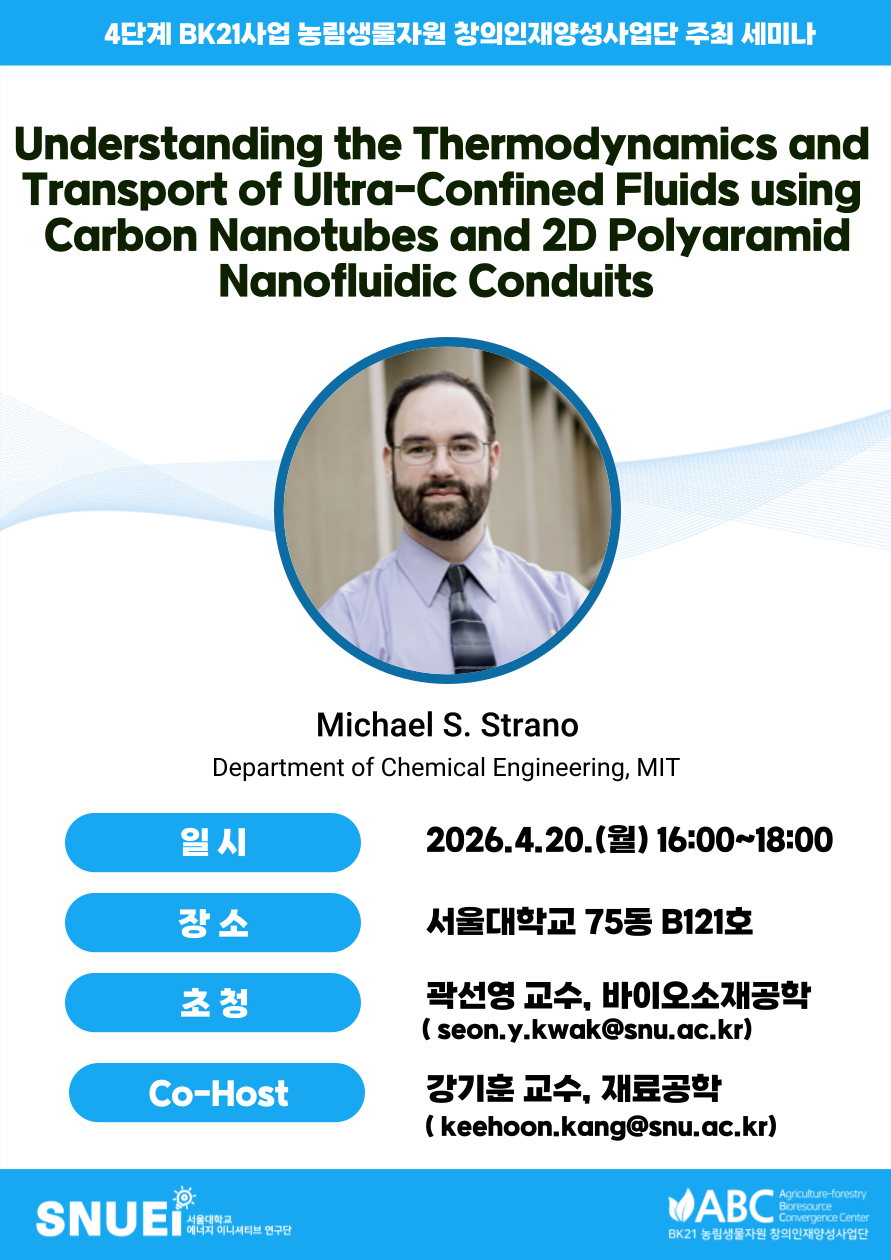
Understanding the Thermodynamics and Transport of Ultra-Confined Fluids using Carbon Nanotubes and 2D···
Abstract
Nanotechnology has given us a large number of new materials with which to confine fluid phases, altering their thermodynamic and transport properties considerably. Over the past decade, my laboratory at MIT has been centrally focused on quantitatively understanding these alternations, and ultimately using them to solve longstanding research challenges. We established the Center for Enhanced Nanofluidic Transport (CENT) at MIT with support from the Department of Energy.
In this presentation, I will highlight our use of two distinct platforms to this end:
(1) the interior of carbon nanotubes as nanofluidic conduits, and
(2) a newly discovered 2D polyaramid polymer recently synthesized by our team, a 2D version of a polymer analogous to Kevlar.
The motivation for using (1) is that the thermodynamic properties of fluids under nano-confinement have been confounded by the enormous surface areas at the nanometer scale, particularly for nanotube systems. This feature generally imparts exquisite mechanical coupling of the conduit to the external environment. Herein, we demonstrate extreme examples as temperature-dependent Radial Breathing Mode (RBM) frequencies in free-standing, electron-diffraction-assigned Double-Walled Carbon Nanotubes (DWNTs) that show large hyperbolic frequency downshifts of 10 to 15%, for systems otherwise completely isolated in vacuum.
Alternatively, when such systems are FIB cut opened and filled using saturated water vapor, the RBMs trace Langmuir isobars and exhibit elliptical trajectories, consistent with theory, allowing measurement of the enthalpy of phase change. We assign the former behavior using a harmonic oscillator model, describing the distinctive frequency cusp and hyperbolic trajectory to a reversible increase in damping from external graphitic domains. The elliptical trajectories after water filling are well described by a Langmuir isobar model, and have allowed us to develop the first fluid Equation of State for ultra-confined fluids and calculate thermodynamic properties. The resulting pair of quantitative theories allows the isolation of confined fluid contributions to nanotube vibrations, providing new insights into nanomechanical coupling, and the basis for new devices and nanofluidic conduits.
Platform (2) holds equal promise to answer questions for confined fluids in 2D geometries. Our recent breakthrough in synthesis (Zeng, et al, Nature, 602, 91, 2022) of irreversibly bonded, solution-phase 2D polyaramid (2DPA-1) presents a promising new material class for manipulating fluids with nanometer-scale precision. The polymer forms 2D nanosheets and platelets, with hydrogen bonding aramid groups built into each surface that allows for strong inter-platelet adhesion.
Here, we report spin-coated nanometer scale 2DPA-1 films, between 3 to 35 nm in thickness, free standing over microwells such that they can be inflated with various gas phases. Remarkably, we find that gas permeabilities through such films are so low, they approach the measurement detection limit (O ~ 10-8 Barrer) of our setup, and are by far the lowest permeability polymer experimentally recorded to date. The films are superbly stable, with barrier properties remaining immutable over the span of two years. This system promises the first gas barrier material commensurate with graphene that can be readily solution phase processed, assembled using facile methods such as spin-coating, and modified using the vast tools of organic chemistry.
Our analysis shows that the inflation of 3-nm-thick bulges suspended across microwells indicates the absence of defects (e.g., pinholes) that commonly plague graphene and other molecularly thin or 2D membrane films. Despite the intrinsic porosity of a single 2DPA-1 platelet, the impermeability, negligible BET surface area, and orientation-dependent fluorescence of its films suggests 2DPA-1 platelets align anisotropically in a tightly packed and staggered order that prevent molecular transport. The findings of this work represent a potential breakthrough for gas barrier materials and warrants further exploration of 2DPA-1 films as selective membranes.